
When Journalism Becomes Narrative Enforcement
Alan Howe’s attack on The New York Times over reports of abuse against Palestinian detainees reveals the growing panic inside sections of Western media as scrutiny of Israel intensifies.

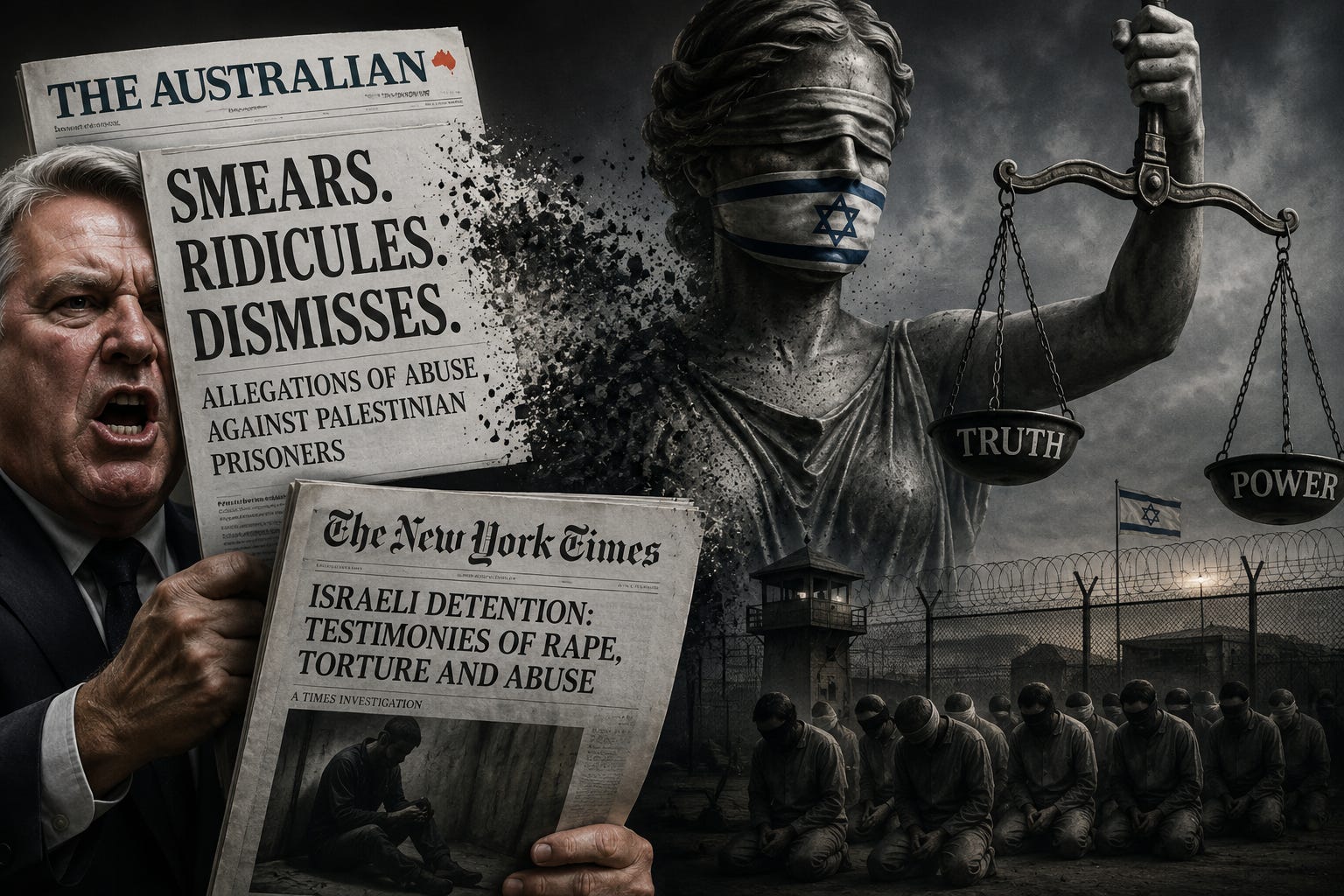
Image: AI generated
A war of truth and fervent denial has emerged between two of the most recognisable mastheads in the world – The Australian and The New York Times. Both newspapers have long been viewed as strongly supportive of Israel and its military campaigns - from Gaza and South Lebanon to Syria and now Iran.
But in recent times, the much-vaunted New York Times appears to have reconsidered aspects of its editorial approach to Gaza and Palestine, publishing stories it may once have avoided. That apparent shift seems to have deeply unsettled Alan Howe, a veteran conservative commentator at The Australian known for his combative opinion writing, culture-war commentary, and strongly pro-Israel editorial stance.
Howe’s furious response to the New York Times investigation into allegations of rape and sexual abuse against Palestinian prisoners says less about journalistic standards and far more about the ideological panic now gripping parts of the Western media establishment whenever scrutiny turns toward Israel.
Rather than seriously confronting the growing body of allegations surrounding abuse inside Israeli detention centres, Howe’s lengthy tirade descends into ridicule, diversion and outright dismissal - another example of the increasingly predictable framing dominating sections of Australia’s Murdoch press.
Central to Howe’s outrage is journalist Nicholas Kristof, whose report detailed testimonies from Palestinian detainees alleging sexual violence, torture and humiliation at the hands of Israeli security personnel and prison guards.
The allegations are horrifying. Which is precisely why they matter.
But instead of calling for independent investigations or demanding transparency from Israeli authorities, Howe dedicates much of his article to mocking the plausibility of individual claims, obsessing over whether dogs can be trained to sexually assault prisoners, and attacking the motivations of Palestinian human rights advocates.
It is a grotesque exercise in deflection.
More importantly, it follows a now-familiar pattern that has emerged across large sections of pro-Israel Western media since the war in Gaza began: allegations against Palestinians are treated as immediate fact, while allegations against Israel are subjected to impossible evidentiary hurdles, ridicule or outright denial.
The contradiction could not be clearer.
Since October 7, much of Australia’s corporate media has amplified Israeli government narratives with little scrutiny. Claims made by Israeli officials have frequently been reported as fact before later being questioned, revised or challenged. Palestinian casualty figures are routinely caveated despite being repeatedly validated by international agencies. Civilian deaths in Gaza are sanitised as “operations” or “collateral damage,” while Palestinian voices themselves are often treated as inherently suspect.
But when allegations emerge implicating Israeli forces in potential war crimes or systemic abuse, suddenly the standards change entirely.
Then comes the scepticism. The forensic nit-picking. And the character assassination.
That is exactly what Howe’s article presents.
What makes Howe’s piece particularly striking is that it entirely ignores the broader international context surrounding the abuse allegations. Human rights organisations, UN experts, medical personnel and even Israeli whistleblowers have raised serious concerns for months about the treatment of Palestinian detainees in Israeli custody.
Reports surrounding facilities such as Sde Teiman have triggered international alarm. Israeli media itself has carried accounts of detainee abuse, including allegations involving beatings, humiliation and degrading treatment.
Yet readers of The Australian would barely know such concerns exist.
Instead, Howe frames the entire issue as though it were simply another anti-Israel conspiracy invented by activists and irresponsibly amplified by gullible journalists.
The real issue here is not whether every individual allegation has yet been independently verified in a court of law. Serious allegations of torture and sexual violence are rarely easy to document, particularly during wartime and within closed detention systems.
The issue is whether such allegations deserve investigation, scrutiny and reporting.
According to Howe’s logic, apparently not.
What makes the article even more disturbing is its underlying dehumanisation of Palestinians themselves. Testimonies are mocked. Witnesses are dismissed. Human rights groups are attacked simply because their founders are Palestinian. Palestinian suffering is treated not as something demanding moral seriousness, but as something requiring immediate suspicion.
Imagine for a moment if the same standard had been applied to Israeli victims following the October 7 attacks.
Imagine a columnist sarcastically questioning whether Israeli hostages were credible enough to deserve reporting.
Imagine sneering at testimonies of abuse.
Imagine ridiculing the plausibility of sexual violence allegations before investigations had concluded.
The backlash would have been instantaneous.
But when Palestinians allege abuse, sections of the Western media suddenly rediscover “healthy scepticism.”
This double standard has become impossible to ignore.
The deeper reality is that establishment media institutions are now struggling to contain a narrative shift taking place globally. Images of destroyed hospitals, dead children, starving civilians and devastated refugee camps have profoundly damaged Israel’s international standing. Younger audiences increasingly distrust the framing long used by traditional Western outlets, particularly Murdoch-owned publications seen as reflexively aligned with Israeli state narratives.
That explains the aggression behind pieces like Howe’s.
The danger for ideological defenders of Israel is no longer fringe criticism from activists - it is mainstream scrutiny. When globally respected institutions like The New York Times begin publishing allegations of rape and systemic abuse against Palestinian prisoners, the old information shield protecting Israel from accountability begins to crack.
And for sections of Australia’s media class, that is intolerable.
Howe ultimately accuses the Times of abandoning journalistic standards. Yet his own article offers almost no serious engagement with the underlying allegations themselves. Instead, it functions as ideological damage control - an attempt to discredit not just the reporting, but the very legitimacy of investigating Israeli conduct at all.
Howe is not presenting journalism, but rather narrative enforcement.
Whether every claim made in the New York Times report is ultimately substantiated through independent investigation remains a matter for due process and evidence. But dismissing allegations of torture and sexual violence through ridicule, sarcasm and political tribalism is not responsible journalism either.
It is propaganda dressed up as commentary. And readers can see it for exactly what it is.
All people like Howe achieve is to make themselves look as ridiculous as they truly are!
Great piece George. The old adage stands up well here. If it walks like a terrorist, and rapes like a terrorist, it’s a terrorist. Israel’s Zionists - I’ll make the distinction from Judaism clear here - have shown the world what inhumanity looks like. For example, their accompaniments to rape and abuse include, the weaponisation of hunger, genocide, ecocide, and industrialised terror. Unfortunately, all of it, the whole nine yards, is just grist for Rupert Murdoch’s profit-producing-propaganda mill.