

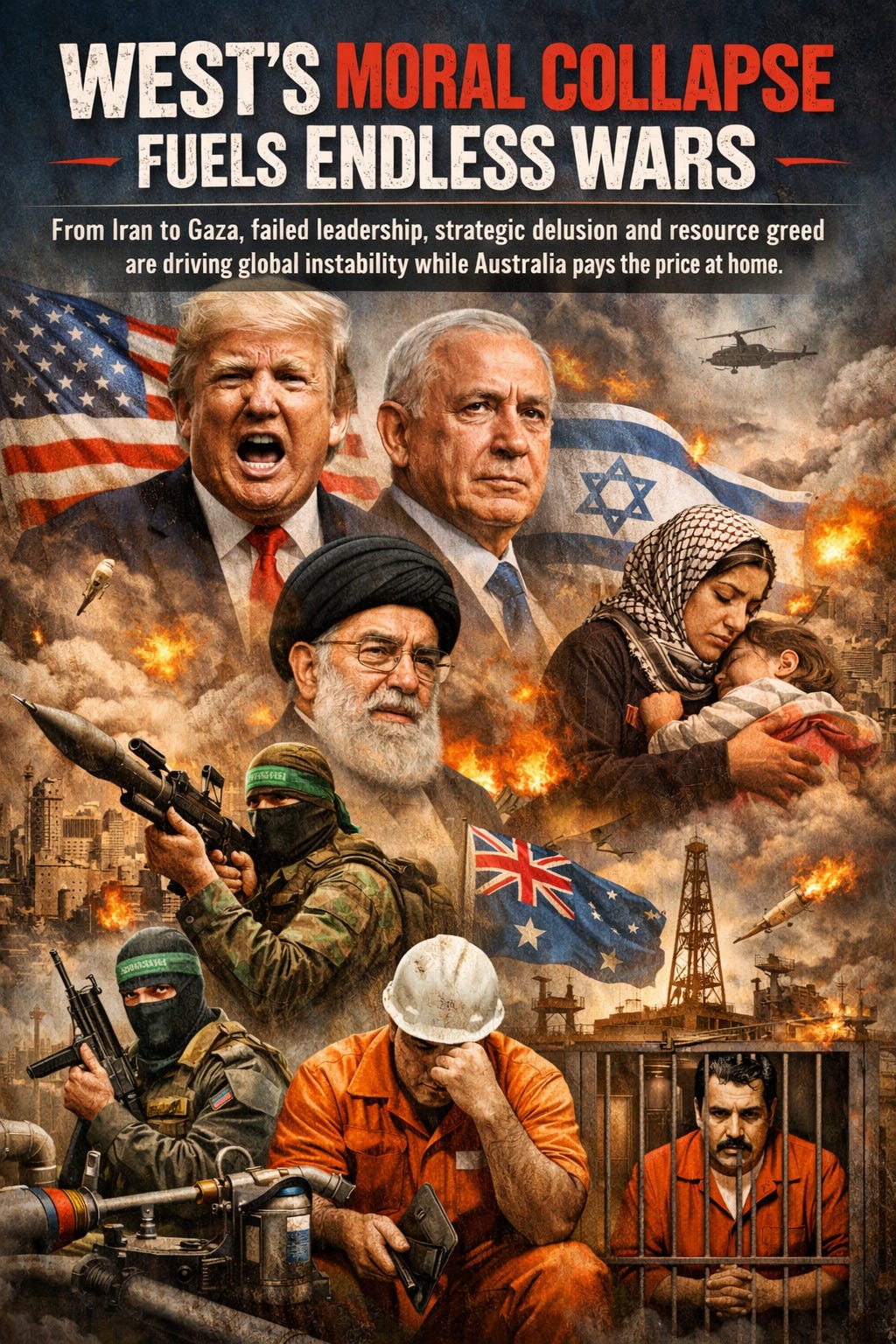
Image: AI generated
The rationing of intellect throughout the Trump administration, along with much of the West’s political leadership, has hit a severe deficit - one that is no longer merely embarrassing, but dangerous. What we are witnessing is not just a decline in strategic thinking or diplomatic nuance; it’s the steady normalisation of moral bankruptcy dressed up as pragmatism, and intellectual dishonesty masquerading as statecraft.
Across Washington, London, and increasingly Canberra, decision-making has been reduced to crude binaries and short-term optics. Complex geopolitical realities are flattened into talking points, and entire nations are caricatured to justify actions that would otherwise be indefensible. Nowhere is this more evident than in the West’s posture toward Iran.
For decades, Iran has been treated not as a civilisation with a 2,500-year history, but as a problem to be solved - preferably through force, coercion, or internal destabilisation. The language is always the same: containment, deterrence, regime pressure. Beneath that language lies a far more cynical objective - to fracture, weaken, and ultimately Balkanise a nation that refuses to submit to Western hegemony.
The strategic logic is as old as empire itself. A unified, sovereign Iran - rich in resources, culturally cohesive, and politically independent - poses a challenge to Western dominance in the region. A fragmented Iran, by contrast, would be easier to influence, to exploit, and to control. Civil unrest, ethnic divisions, economic strangulation - these aren’t unintended consequences of Western policy; they’re, in many respects, the policy.
What’s most striking isn’t just the aggression, but the profound misunderstanding underpinning it. Western leaders, insulated by their own narratives, have consistently failed to grasp the depth of Iranian identity. Iran is a nation forged through invasion, revolution, and resilience. Its sense of sovereignty is non-negotiable.
That failure of understanding has consequences. It’s why pressure campaigns haven’t broken Iran but hardened it and why attempts at isolation have instead driven new alliances. And it’s why, in the current climate, Iran isn’t merely enduring - but adapting, recalibrating, and, winning the war..
Nowhere is the intellectual bankruptcy of Western strategy more exposed than in its repeated misreading of non-state resistance movements. Time and again, Western leaders and their allies declare victory prematurely -confident that overwhelming force has neutralised groups like Hezbollah or Hamas - only to be confronted with their re-emergence, more entrenched and more capable than before.
The assumption Hezbollah had been diminished or neutralised reflects a fundamental failure to understand how resistance movements work. They’re not conventional armies that collapse when infrastructure is degraded or leadership targeted. They’re adaptive, decentralised, and deeply embedded within the societies they claim to defend. Periods of apparent quiet aren’t signs of defeat – they’re phases of recalibration.
What we’re witnessing isn’t the death of such movements, but their evolution. The reassertion of Hezbollah’s operational capacity in southern Lebanon, its ability to regroup and project force, and its positioning as a defender of Lebanese sovereignty, all point to a reality Western policymakers have repeatedly failed to grasp - you can’t bomb an ideology out of existence, particularly when that ideology is reinforced by lived experience.
The same applies to Hamas. Despite relentless military campaigns, despite vast asymmetries in firepower, the organisation continues to resist. This is a recognition of reality. Movements that are rooted in grievance, identity, and perceived injustice do not simply disappear under bombardment. If anything, such conditions often sustain and even strengthen them.
And beyond Lebanon and Gaza, the potential for broader regional escalation looms. Yemen, long treated as a peripheral theatre, now sits as a strategic wildcard. Its positioning within the regional axis aligned against Western and Israeli interests signals that any further escalation risks drawing in additional actors, expanding the conflict in ways that Western planners appear either unwilling or unable to fully anticipate.
Even now, the response from Western capitals remains anchored in the same flawed assumptions: that force will compel submission, pressure will fracture alliances, escalation can be controlled. It’s a doctrine not just of dominance, but of denial of history, culture, and of the limits of power.
Compounding this is the role of regional allies - states that have, for decades, functioned as extensions of Western strategic interests. Saudi Arabia, the UAE, Jordan, Qatar, Kuwait, Bahrain - each plays a role in maintaining a regional order aligned with Western priorities. But their involvement also underscores a deeper truth: the geopolitical architecture of the Middle East has been shaped as much by external influence as by internal dynamics.
The Middle East is a region perpetually on edge, where sovereignty is conditional, alliances are transactional, and stability is often sacrificed for strategic positioning.
This same moral and intellectual collapse is evident in the West’s handling of Palestine. The ongoing devastation in Gaza has laid bare a level of hypocrisy that is impossible to ignore. Western leaders speak endlessly of international law, human rights, and the rules-based order - until those principles become inconvenient.
The scale of destruction, the targeting of civilian infrastructure, the humanitarian catastrophe unfolding in real time - these are not abstract debates. They are documented realities. Yet the response from Western capitals has been one of equivocation, deflection, and, in many cases, outright complicity.
Comically, Israel now being decimated by Iran and the power of its missiles scream about the inhumanity, the immorality and the abuse of international law Iran has displayed when attacking Tel Aviv, Haifa. The Hypocrisy is amazing and what’s even more revealing, the world show’s no sympathy to the genocidal maniacs who cheered and partied when Palestinians were being slaughtered. Fuck Israel!
Karma is a bitch and they now know of and understand the Gaza experience.
What does it say about a political order that can mobilise instantly in defence of some lives, while rationalising the destruction of others? What does it say about leaders who invoke morality selectively, depending on strategic alignment? This is not leadership. It is moral triage dictated by power.
Lebanon, too, has paid the price of this worldview. Repeated cycles of destruction, justified under the banner of security, have left a nation perpetually on the brink. Infrastructure shattered, economies destabilised, civilian populations caught in the crossfire - these outcomes are treated as collateral, rather than consequences.
And beyond the Middle East, the pattern continues. In Latin America, the language shifts, but the logic remains. Sovereignty is conditional. Leadership is legitimate only if it aligns with Western interests. When it doesn’t, the tools of pressure - sanctions, isolation, and, at times, more covert interventions - are deployed with little regard for international norms.
Taken together, these actions form a consistent picture: a Western political class that has abandoned even the pretence of consistency. Principles are no longer guiding frameworks; they are instruments to be used, or discarded, as required.
For Australia, the implications are both immediate and profound.
For years, successive governments - on both sides of the political spectrum - have tethered Australia’s strategic and economic future to the US. This alignment has often been framed as necessary, even inevitable. But what has it delivered?
In energy policy, the consequences are stark. Australia, one of the most resource-rich nations on earth, finds itself in the paradoxical position of lacking true energy independence. Vast reserves of gas and oil have been exported under frameworks that prioritise corporate profit over national security. Domestic supply has been constrained, prices have risen, and the country has become increasingly exposed to global volatility.
The absurdity is difficult to overstate. A nation that should be insulated from energy shocks is instead vulnerable to them. A nation that could leverage its resources for public benefit -funding hospitals, universities, and infrastructure -is instead forced to navigate shortages and price spikes.
Recent analysis has underscored the scale of this failure: the cost of effectively “buying back” Australia’s own gas on international markets, at inflated prices, represents not just an economic inefficiency but a transfer of national wealth. Funds that could have been directed toward public services—healthcare, education, infrastructure—are instead absorbed by a system that privileges export over domestic need.
This isn’t an accident. It is the result of policy choices -choices shaped by ideological alignment, lobbying pressure, and a failure to prioritise national interest. The refusal to assert control over domestic resources, the reluctance to challenge multinational interests, and the blind adherence to market orthodoxy have combined to produce a situation that borders on strategic negligence.
And now, as global tensions escalate -driven in no small part by the erratic and confrontational posture of the Trump administration - Australia finds itself exposed. Economic instability, supply chain disruptions, and the risk of broader conflict all loom large. Yet the capacity to respond is constrained by years of underinvestment, policy inertia, and strategic dependency.
The tragedy is not just that these outcomes were avoidable. It is that they were foreseeable.
Warnings about over-reliance on foreign alliances, about the dangers of resource mismanagement, about the erosion of sovereign capability—these have been raised repeatedly. But they have been ignored, dismissed, or sidelined in favour of short-term political gain.
What we are left with is a political landscape defined by timidity at home and complicity abroad. Leaders who speak of strength while deferring to external agendas. Policymakers who invoke national interest while undermining it in practice.
The broader question, then, is not simply one of policy failure. It is one of accountability.
How did we arrive at a point where intellectual rigor is replaced by talking points? Where moral clarity’s subordinated to strategic convenience? Where the lives of millions can be weighed against political alliances and deemed expendable?
The answer lies, in part, in the erosion of standards. A political culture that rewards conformity over courage, alignment over independence, and rhetoric over substance inevitably produces leadership that reflects those values.
Reversing that trajectory will require more than incremental reform. It will require a fundamental reassessment of priorities - one that places sovereignty, accountability, and genuine strategic thinking at the centre of decision-making.
It will require leaders willing to challenge assumptions, to resist external pressure, and to engage with the world not through the lens of dominance, but through the principles they so often claim to uphold.
Until then, the deficit will remain - not just of intellect, but of integrity. And the cost of that deficit will continue to be measured not in political fortunes, but in human lives.
Since my childhood in the 1960's Zioniam has polluted my culture-western culture. Seing Israel look like Gaza would be delightful- long wasted for.. Karma can't come soon enough for me.
We are frozen in the bankruptcy of sovereignty where ALL governments of the West are agents of war each in their own despicable way.