
Washington’s Great Miscalculation
From threats of obliteration to calls for restraint, Trump’s changing tone may reveal the failure of a decades-long strategy built on arrogance, wishful thinking and a failure to understanding Iran.

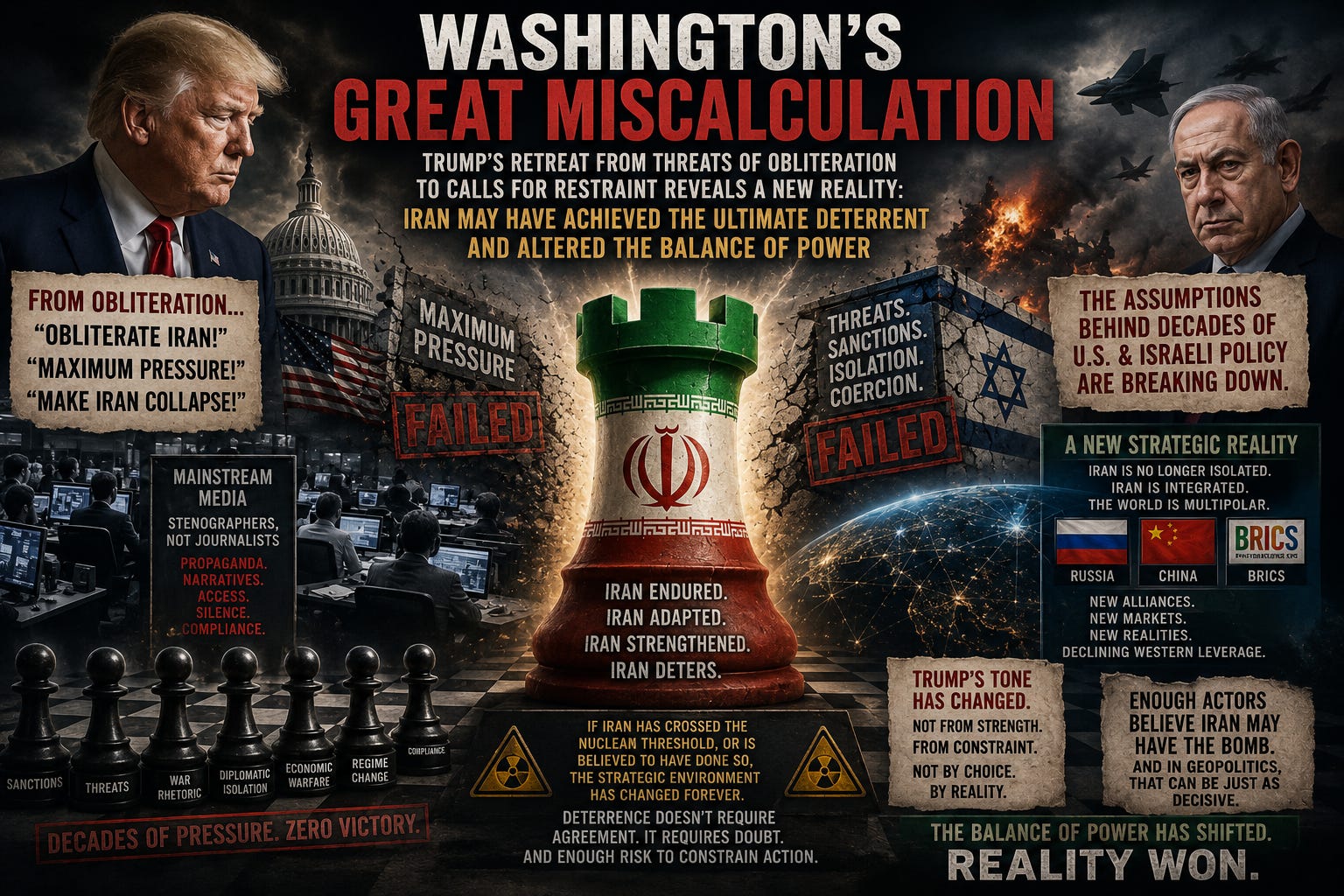
Image: AI generated
Not too long ago, the newsrooms of media organisations were filled with relentless journalists committed to ensuring crooked politicians and CEOs were held accountable, and corruption was treated as the dirty ten-letter word it was rather than the accepted practice it too often appears to be today.
But the old-school news hounds are disappearing. In their place stand stenographers – corporate flunkies masquerading as journalists, dutifully transcribing approved narratives and calling it reporting.
Dedicated newshounds still exist, but they are increasingly rare in today’s world of propagandised news and manufactured consent. Modern mainstream media is saddled with frauds, careerists and cowards – individuals incapable of genuine independent thought and trapped beneath the weight of their own decaying ethics, intellectual laziness and moral compromise.
This is the world we now endure: journalists who pad up for the political class, where accountability has become a relic of a bygone era, scrutiny is treated as heresy, and truth is routinely sacrificed at the altar of access, ideology and political convenience.
Nowhere is this failure more apparent than in the coverage of Iran. The inability – or unwillingness – of much of the Western media to seriously question the rationale behind yet another confrontation in the Middle East reveals an industry that has largely abandoned its most fundamental responsibility: challenging power rather than serving it.
While geopolitical ignorance dominates large sections of the mainstream media – or perhaps a deliberate refusal to confront inconvenient realities – there has been a remarkable failure to recognise Trump’s shifting tone on Iran. This is not simply a matter of temperament. It may be the clearest signal yet that the assumptions underpinning decades of American and Israeli policy towards Tehran are beginning to collapse under the weight of their own contradictions.
Trump is the same political figure who only months ago spoke casually about “obliterating” Iran, projecting an image of unchallengeable power and portraying confrontation as both manageable and inevitable. His posture rested on a belief shared across Washington’s foreign-policy establishment: that Iran, subjected to sufficient pressure, could eventually be coerced into submission.
That belief increasingly appears detached from reality.
The so-called maximum-pressure campaign was not a marginal policy. It was a comprehensive strategy of economic warfare and political coercion designed to isolate Iran internationally, fracture it internally and ultimately force capitulation.
Instead, Iran endured.
Not without cost. Not without hardship.
But crucially, without collapse.
Its institutions held. Its regional influence survived. Its strategic posture adapted. And in many respects, its geopolitical position strengthened.
What has changed most is not Iran’s intent, but its position.
Mainstream media’s weakness has allowed independent journalism to thrive in an environment where distrust increasingly shapes public opinion and audiences have grown weary of being lectured to by journalists who often appear more like political operatives than independent observers.
It is within this context that the reporting of Larry Johnson and Pepe Escobar – citing what they describe as a highly credible senior Pakistani political source – assumes significance.
Their claim that Iran may now possess a nuclear weapon capability cannot simply be dismissed as noise. It remains unverified in the public domain, but it is precisely the kind of assertion that circulates within serious geopolitical circles and influences strategic thinking behind closed doors.
And that is the point too often missed.
In international politics, it is not only confirmed capabilities that matter. It is the credible possibility of them.
If Iran is now viewed as having crossed, or being on the verge of crossing, the nuclear threshold, then the strategic environment changes immediately and profoundly.
Deterrence does not require universal agreement.
It requires enough doubt.
Enough uncertainty.
Enough risk.
North Korea demonstrated this with brutal clarity.
Before Pyongyang developed a credible nuclear deterrent, American politicians openly discussed regime change. Military action was regularly floated and the survival of the North Korean state was constantly questioned.
The moment North Korea demonstrated a credible nuclear capability, the conversation changed.
Almost overnight.
Washington went from threatening destruction to seeking meetings. American presidents who once threatened war suddenly found themselves sitting across the table from North Korean leadership.
Nuclear weapons transformed North Korea from a target into a problem that had to be managed.
If Johnson and Escobar are right, then Iran may have achieved the same status and history is repeating itself.
The reality many in Washington refuse to acknowledge is simple: deterrence works.
It may be uncomfortable.
It may be dangerous.
But it works.
Countries possessing credible strategic deterrence are treated fundamentally differently from countries that do not.
Libya surrendered its weapons program and was destroyed.
Iraq had no nuclear deterrent and was invaded.
North Korea built nuclear weapons and survived.
The lesson could not be clearer.
For years Iran watched these examples unfold.
It observed what happened to nations that complied with Western demands.
And it observed what happened to nations that resisted.
If Tehran has now secured a nuclear deterrent, it would represent one of the most significant strategic victories in modern geopolitical history.
More importantly, it would represent a devastating failure for American and Israeli strategy.
For decades the United States spent billions attempting to isolate Iran.
Successive administrations imposed sanctions, orchestrated diplomatic campaigns, conducted covert operations and sought to cripple Iran’s economy.
Israel repeatedly warned that Iran would never be allowed to cross the nuclear threshold.
Yet if Johnson and Escobar’s Pakistani source is correct, not only did Iran survive the pressure, it succeeded despite it.
It would make the entire Western strategy one of the most expensive and spectacular failures of modern statecraft.
The failure extends beyond military and intelligence circles.
It also becomes a public relations disaster.
Across much of Asia, Africa and Latin America, perceptions of the conflict differ dramatically from those promoted in Washington and Tel Aviv.
Many countries increasingly view Iran as a nation that stood against overwhelming pressure and emerged stronger.
Whether one agrees with that assessment is largely irrelevant.
Perception matters.
And across much of the Global South, the perception is that the West’s moral authority has been badly damaged.
Years of military interventions, sanctions regimes and selective applications of international law have generated deep scepticism towards American leadership.
Meanwhile, Iran has positioned itself as part of a broader movement challenging Western dominance.
This is where Russia, China and BRICS enter the equation.
The emergence of a multipolar world has fundamentally altered the strategic environment.
Twenty years ago Iran could be isolated.
Today it cannot.
Russia has strengthened military and economic ties with Tehran.
China views Iran as a critical component of its long-term strategic ambitions and energy security architecture.
BRICS has provided Iran with access to economic and diplomatic networks that significantly reduce the effectiveness of Western pressure.
Instead of being isolated, Iran is increasingly integrated into an emerging global order that operates independently of Washington.
Ironically, the United States may have helped create the very outcome it sought to prevent.
Every sanction pushed Iran closer to China.
Every threat pushed Iran closer to Russia.
Every attempt at isolation accelerated the development of alternative economic and political structures.
The result is a stronger Iran and a weaker Western position.
And it appears Trump is beginning to recognise this reality.
Despite his reputation for bluster and bravado, Trump has always demonstrated an instinct for recognising when circumstances have changed.
His rhetoric towards Iran today is notably different because the facts on the ground may be different.
If Iran does possess a nuclear deterrent, military solutions become infinitely more complicated.
The risks become catastrophic.
The consequences become unpredictable.
And suddenly the language of “obliteration” gives way to the language of negotiation.
The greatest irony of all is that Washington and Tel Aviv may have inadvertently validated the very argument Iran has been making for years.
That only strength guarantees survival.
That only deterrence prevents aggression.
And that only strategic independence protects national sovereignty.
If the reports circulating within intelligence and geopolitical circles are true, historians may look back on this moment as the point where the balance of power in the Middle East irreversibly shifted.
Not because Iran won a military battle.
But because it won a strategic war.
A war of endurance.
A war of patience.
A war against overwhelming economic, diplomatic and military pressure.
And perhaps most significantly, a war that exposed the limitations of American power in an increasingly multipolar world.
For decades Washington believed it could dictate outcomes.
Today it appears increasingly forced to adapt to them.
Empires often recognise decline long after the rest of the world has already noticed.
The sudden change in Trump’s tone towards Iran may be a sign that reality has finally caught up with the hubris that for years passed as strategy in Washington.
Whether Iran has definitively crossed the nuclear threshold or not, the more important reality may be this: enough actors appear to believe that it might have.
And in geopolitics, that can be just as decisive.
No disagreement here George. In 2026, if I had to make a choice between living in the USA or Iran…let’s just say I would be eating Kebab Koobideh.
Western media as a monolith is dead. European media are rapidly repositioning the EU as a countervailing force of reason and truth. Trump's assault on NATO has incentivized them to push back against American disinformation. Ongoing Russian aggression is forcing the EU to speak with one voice. And corrupt American politicians are financing the morally indefensible Palestinian genocide. Outside of MAGA, billionaires, and some hapless diplomats, the entire planet wants to see Trump humiliated. Europe is no exception.