

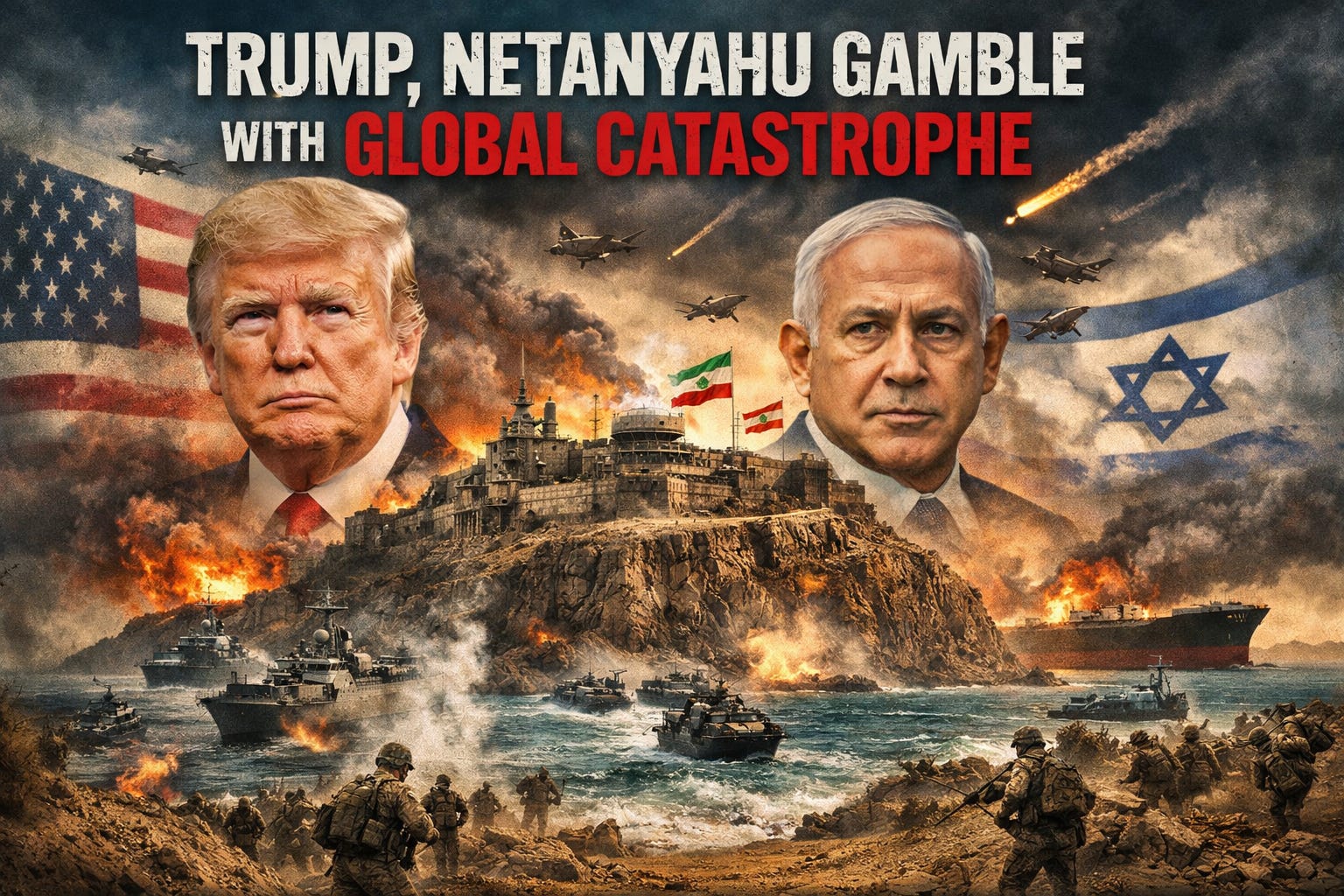
Image: AI generated
Not much can be said about Americans that’s complimentary when it comes to geopolitics or world history—particularly of the generation that continues to shape Washington’s strategic instincts—the “Silent Generation” and “Baby Boomers.”
American history and war, however, are a different matter; on those fronts, they’re well versed, often obsessively so. But that lens—fixated on their own mythology—has come at a cost: a profound and dangerous ignorance of the world beyond it.
American ignorance is no longer academic. It is now driving events that threaten global stability.
Under Trump, the US, alongside Israel under Netanyahu, has dragged the world into a war with Iran that is as reckless as it is avoidable. What was framed as regime change has rapidly spiralled into escalation—sold as strength, it has revealed itself as strategic buffoonery and incoherence.
And now, in a move that defies logic and history, Trump is preparing to send US forces toward Kharg Island—an Iranian stronghold at the centre of the Persian Gulf’s energy lifeline—in a desperate attempt to force open the Strait of Hormuz and buttress a global economy now buckling under the weight of war.
Trump’s obvious panic is dressed up as power. With the global economy on edge, energy markets volatile, and supply chains strained, the very crisis he now seeks to “fix” is one his administration helped create—led by the nose by Netanyahu and his long-standing ambition to confront Iran militarily.
The Iran war was not inevitable. It was chosen.
Chosen through provocation, miscalculation, and a deeply ingrained belief—shared in Washington and Tel Aviv—that overwhelming force can substitute for strategy, and that adversaries will fold under pressure.
Iran has not folded. Instead, it has exposed the fatal flaw at the centre of this campaign: a catastrophic underestimation of its capabilities, resilience, and willingness to fight.
Far from collapsing, Iran has adapted, absorbed US and Israeli strikes, and recalibrated—pushing back hard. It has leveraged asymmetric tactics, regional positioning, and increasingly sophisticated military technology. The assumption that Iran would be quickly subdued now looks not just naïve, but dangerously detached from reality.
Iran is not simply surviving—it is shaping the battlefield.
It is a truth Washington refuses to acknowledge.
Because acknowledging it would mean admitting the war—launched under the guise of control—has slipped beyond its grasp.
Which is precisely why Kharg Island now looms so large.
Seizing Kharg is being framed as a strategic necessity: a way to reopen the Strait of Hormuz, restore oil flows, and reassert control over a deteriorating situation. But the underlying reality is political survival—salvaging authority and projecting dominance in the face of mounting failure.
Trump the gambler is rolling the dice—recklessly.
Kharg Island is a fortress—mountainous, fortified, and deeply embedded within Iran’s defensive architecture. Any attempt to seize it would require not just military force, but an extraordinary tolerance for casualties and escalation.
Yet the rhetoric suggests this reality is being ignored—bringing with it the most damning indictment of all: a refusal to learn from history.
In 1915, Australian and New Zealand forces stormed the beaches of Gallipoli—cannon fodder on behalf of the British Empire. The Empire believed superior planning and firepower would carry the day. Instead, they walked into a massacre.
Turkish forces, positioned on high ground and cliff tops, turned the beaches below into a killing field. The ANZACs were not defeated by lack of courage—but by catastrophic misjudgment from those who sent them there.
It was a clear and brutal lesson: terrain matters. Preparation matters. And arrogance kills.
More than a century later, those lessons appear to have been forgotten.
Kharg Island presents many of the same strategic challenges—only worse, amplified by modern warfare. Elevated defensive positions. Limited access points. The IRGC—and advanced weaponry capable of targeting invading forces with precision and speed.
This is 2026, not 1915.
Sanctioned for decades, demonised and isolated, Iran has been forced to become self-sufficient, innovative, and highly adaptive—and it has. It possesses drones, missiles, and surveillance systems capable of turning any assault into a slaughter within minutes.
And still, Trump allows himself to be led by Netanyahu as they press forward.
The problem is not just military—it is intellectual. A systemic failure within US strategic thinking that continues to prioritise dominance over understanding, escalation over restraint, and ideology over reality.
This same failure defined Vietnam, Iraq, Afghanistan—and now, it is defining this war with Iran.
Each time, the pattern is the same: overconfidence, misreading of the adversary, and a belief that technological superiority guarantees success. Each time, the outcome is the same: prolonged conflict, immense human cost, and eventual strategic failure.
And yet, nothing changes.
For Netanyahu, this war aligns with a long-standing strategic posture—one that has consistently framed Iran as an existential threat requiring confrontation. But what is presented as security is, in practice, perpetual escalation.
For Trump, the motivations are more immediate—and more dangerous.
His presidency is driven by optics, dominance, and the need to project strength at all costs. The economic fallout of this war threatens that image. A closed Strait of Hormuz, spiralling oil prices, and a destabilised global economy are not just geopolitical challenges—they are political liabilities.
Kharg Island, then, becomes a stage.
A high-risk, high-stakes attempt to reclaim control of a narrative that is slipping away.
But wars are not narratives. They are realities. And reality has a way of dismantling illusion with brutal efficiency.
If US forces are deployed against Kharg Island, the consequences will not be contained. Iran will respond—not just defensively, but asymmetrically—widening the war. Regional actors will be drawn in, and global markets will react violently.
This is how escalation becomes conflagration.
And it is entirely avoidable.
What makes this moment so dangerous is not just the military calculus—it is the absence of restraint. The absence of humility. The absence of any serious attempt to de-escalate a situation that is clearly spiralling.
Instead, the world is witnessing the convergence of two leadership styles—Trump’s impulsive aggression and Netanyahu’s entrenched militarism—driving the world toward a confrontation that serves neither stability nor security.
And the cost of that miscalculation will not be borne by them alone.
It will be borne by soldiers sent into impossible terrain. By people caught in widening conflict zones. By economies pushed to breaking point. And by a global order already strained to its limits.
History is not subtle about these moments.
It warns. It repeats. It exposes.
Gallipoli was not just a tragedy—it was a lesson in the consequences of arrogance and ignorance. A reminder that wars are not won by belief, but by understanding.
To ignore that lesson—to march toward Kharg Island as though history means nothing—is not just reckless.
It is a failure of leadership so profound that its consequences will be felt for generations.
And once again, everyone else will pay the price.
You are doubtless correct, George. However, I am afraid you overlook one other consideration. Trump and his billionaire/centi-millionaire buddies know the next move AHEAD OF TIME. This enables them to make outrageous amounts of money financially, and it's as simple as betting on a football game that has already been played. They can buy, sell, and sell short; they can purchase options (calls and puts); they can deal with oil futures.
I am far from the only one who believes this. Robert Reich posted this column on substack 25 March: https://robertreich.substack.com/p/trading-on-trump
Bottom line: Yes, it may destroy the US and damage the entire world; it may cause incalculable suffering and loss of life; the environmental consequences may be catastrophic, BUT WHY SHOULD TRUMP CARE? HE AND HIS BUDDIES WILL "CLEAN UP" FINANCIALLY. [...and don't forget that 20-year-old Barron Trump, who has never worked a day in his life, is already worth an estimated $150 million!]
The arrogance and stupidity of this move by Trump is hard to believe. This war will change the world, and I hope we are able to survive it.