

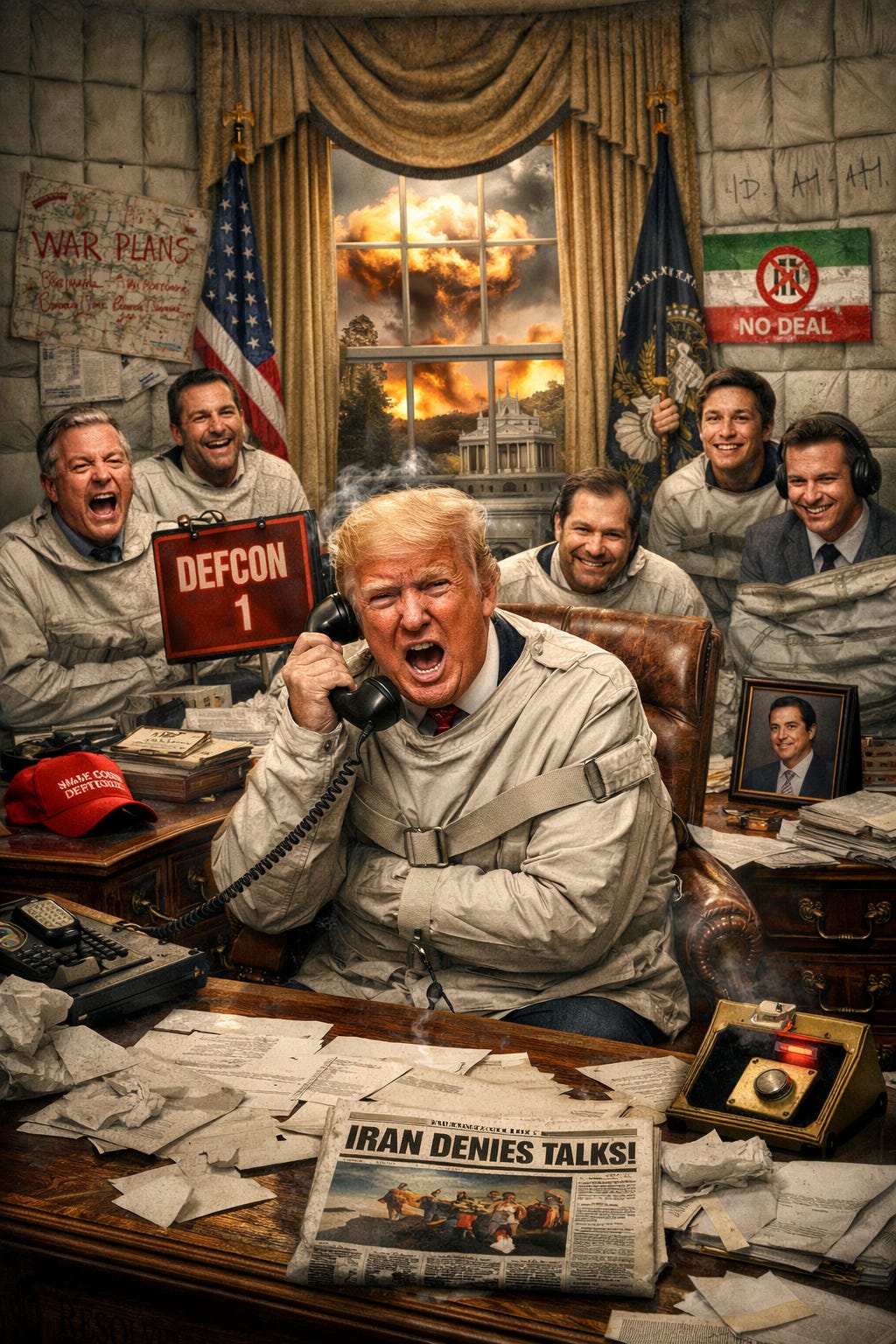
Image: AI generated
There are moments in global politics when rhetoric becomes so detached from reality it ceases to be merely misleading but dangerous instead. What unfolded in the White House this week, following Trump’s abrupt reversal on striking Iran’s electricity grid, was not another example of political spin.
It was something far more alarming - a demonstration of erratic decision-making, fabricated narratives, and a level of detachment from verifiable fact that raises serious questions about the stability of the US Presidency.
The sequence of events is extraordinary. A 48-hour ultimatum issued to Iran - framed in the familiar language of brinkmanship and force - suddenly evaporated. The promised military action did not occur. Instead, the world was presented with a new story: Iran had reached out, negotiations were underway, and envoys tied to Trump’s inner circle - including Steve Witkoff and Jared Kushner - were engaged in backchannel diplomacy. A five-day “grace period,” we were told, had been granted as part of this supposed breakthrough.
There is, however, a fundamental problem. There is no credible evidence any of this happened.
In fact, Iranian officials have explicitly and emphatically denied the core claims made by Trump. Tehran rejected outright the suggestion it initiated contact, denied any phone call or message was sent to Trump, and dismissed the notion it had entered into — or even agreed to consider - peace negotiations under these circumstances.
There has been no acknowledgement of backchannel talks involving Witkoff, Kushner or any unofficial intermediaries. No signal, public or private, that aligns with the version of events presented by the White House.
This isn’t ambiguity. It is direct contradiction.
And yet, despite that clear denial, the narrative put forward by Trump has not been corrected or clarified. Instead, it has been repeated - layered with additional claims that further strain credibility.
Trump asserted Iranian officials had “called him directly,” a claim now squarely refuted by Tehran. He suggested negotiations were progressing toward a peace framework, despite Iran’s categorical rejection of any such process. He spoke of coordinated diplomatic engagement through figures with no formal standing in negotiations. Each element collapses under even minimal scrutiny.
Then came the “five-day grace period” - presented as a calculated act of restraint. This too appears to have been constructed after the fact, a retrospective justification designed to reframe what was, in reality, a climbdown from an ultimatum that had boxed the administration into a corner.
Individually, each of these claims might be dismissed as exaggeration. Together, they form a pattern - one that is increasingly difficult to ignore.
This is not strategy. It is improvisation bordering on fantasy.
The concern isn’t simply Trump changed course. Strategic recalibration can be wise. The concern is that the explanation for that recalibration appears to be built on assertions that are not just unverified but directly contradicted by the other party involved.
And this is where the deeper issue emerges.
The Oval Office, under Trump’s current leadership, is beginning to resemble something far more chaotic than a seat of calculated power. It is becoming an echo chamber - one in which claims are made, repeated, and reinforced without challenge, regardless of their grounding in reality.
Figures like Marco Rubio, Lindsey Graham, Ted Cruz, Pete Hegseth, Scott Bessent and JD Vance have not acted as a stabilising counterweight. Instead, they have amplified the administration’s posture - endorsing hardline rhetoric, supporting ultimatums, and then pivoting seamlessly to defend the shifting explanations that follow. There is little sign of internal resistance, no visible friction, and no indication that anyone in the room is prepared to say: this does not add up.
The absence of restraint is not just political - it is structural.
And the consequences are global.
When a leader issues threats of military action and then retracts them while constructing an alternative narrative - one that is directly denied by the supposed counterpart - adversaries do not interpret this as strength. They see unpredictability, a system in which statements cannot be taken at face value, and where official accounts diverge sharply from reality.
For Iran, this creates both risk and opportunity. Risk, because misreading an erratic signal can trigger escalation. Opportunity, because an opponent perceived as inconsistent is easier to manipulate and harder to deter.
But the implications extend beyond Iran.
Allies are watching. Intelligence agencies are assessing. Markets are reacting. And what they are seeing is not simply volatility, but a pattern of statements increasingly detached from verifiable fact - even when those facts are publicly and unequivocally disputed.
This pattern has been building.
Claims of imminent breakthroughs that never materialise. Assertions of secret agreements that cannot be traced. Repeated instances where events are described in ways that diverge sharply from independently observable reality. What was once political hyperbole is now bleeding into matters of war and peace.
And that is where it becomes dangerous.
Because decision-making at this level cannot rely on narrative construction. It requires clarity, consistency, and a shared understanding of facts - both within an administration and between nations. Without that, communication breaks down.
And when communication breaks down, miscalculation follows.
And this is where the danger compounds - because Trump’s detachment from verifiable reality is converging with the hardline, expansionist posture of and another psychopath and genocidal lunatic Netanyahu.
Netanyahu’s leadership has always been defined not by restraint, but by escalation. The scale of destruction in Gaza, the mounting civilian toll, and the systematic dismantling of infrastructure have drawn condemnation from humanitarian organisations, legal experts and large sections of the international community. War crimes - and genocide - are now fact.
Netanyahu and members of his psychotic government have repeatedly advanced claims about Hamas’s actions that have, in several instances, been shown to be a lie.
Justifying escalation, the framing of enemies, the shaping of international opinion - all depend on claims that must withstand scrutiny. When those claims are exaggerated, selectively presented, or later contradicted, they distort public understanding and help create the conditions in which further violence becomes easier to justify.
Netanyahu’s approach has been consistent: define the conflict in absolute terms, reject external pressure, and pursue military objectives with minimal concession to international criticism. It is a strategy that prioritises dominance over de-escalation and keeps the region in a state of permanent volatility.
Place that alongside Trump who is issuing ultimatums, fabricating diplomatic breakthroughs that Iran itself has explicitly denied, and reshaping events in real time to fit a preferred narrative.
This is not a stabilising alliance. It is a convergence of two leadership styles that, in different ways, erode the boundary between reality and political construction.
One relies on maximalist military psychopathy and contested justifications for sustained warfare. The other increasingly appears to rely on invented scenarios and unverified claims to explain away strategic reversals.
Together, they create a feedback loop of escalation and distortion.
When narratives are untethered from facts - whether in the justification for war or the avoidance of it - the risk is no longer just misinformation.
It is miscalculation.
The phrase “on the precipice of World War III” is often invoked carelessly. But the ingredients that make large-scale conflict possible are not always dramatic. They are incremental: a misread signal, an unverified claim, an adversary acting on an assumption that proves false.
What we are witnessing increases the likelihood of those conditions.
Because when threats are issued without follow-through, when reversals are explained through narratives that are openly disputed, and when those narratives are accepted without scrutiny by those closest to power, the system loses coherence.
And without coherence, stability cannot be sustained.
The Oval Office has always been a place of immense consequence. But it has also, historically, been anchored by a relationship to reality - however contested that reality might be.
What is unfolding now suggests that anchor is slipping.
And if it continues to slip, the consequences will not be confined to Washington. They will be felt in capitals across the world - in decisions made, in risks taken, and in conflicts that might otherwise have been avoided.
Because the most dangerous thing in international politics is not aggression alone. It’s aggression guided by delusion.
"Clarity, consistency and a shared understanding of facts" can never come from a White House that has become, as your illustration so accurately depicts, a lunatic asylum for the criminally insane!
George, there is more uncertainty and more warnings by more writers Armageddon/WWIII is shimmering on the horizon, than ever before that I've seen in my 82 Years.
Even though I've warned for the last 50 years the leading indicators are pointing to it, I have no pleasure seeing the circumstances taking shape before our very eyes Day by Day with the Trump Presidency.
While I was not seeking it, to my surprise and wonder I was 'Born Again' unexpectedly Resurrected from the Spiritually Dead February 1, 1975 so long ago.
It took 38 years before the reason why came into focus, publishing this article in my Blog 15 years ago.
https://rayjc.com/2011/12/25/day-of-awakening-david-vs-goliath-vs-armageddon/